

The Future of Continuing Medical Education: Xpeer White Paper 2026
Written by Xpeer,
Category: Endocrinology & Diabetes
Continuing medical education is undergoing a profound transformation. As healthcare systems face increasing complexity, digital acceleration, and evolving professional expectations, traditional CME models are no
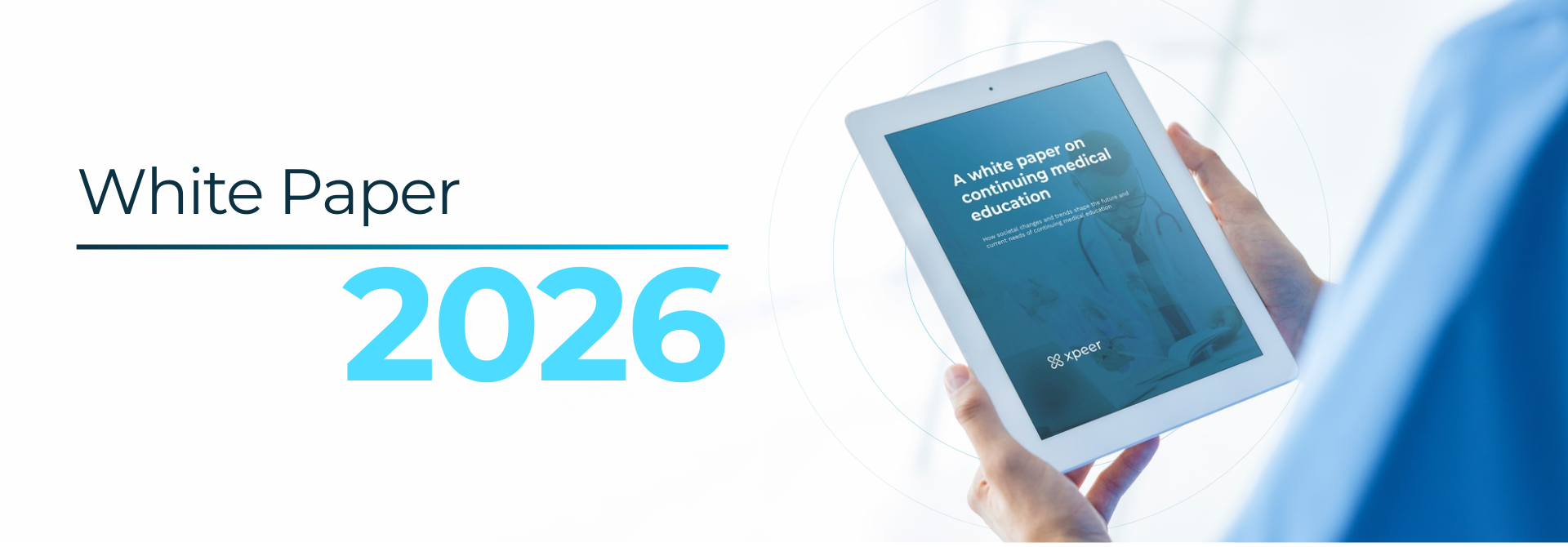
Continuing medical education is undergoing a profound transformation. As healthcare systems face increasing complexity, digital acceleration, and evolving professional expectations, traditional CME models are no longer sufficient. Xpeer’s 2026 White Paper explores how medical education must adapt to remain relevant, effective, and aligned with real clinical practice.
For today’s healthcare professionals, CME is no longer just about accumulating credits. It is about staying clinically sharp, digitally competent, and prepared for new care models. The White Paper offers a forward-looking framework for this new era of learning.
Why continuing medical education needs to evolve
Continuing medical education has historically relied on static formats, periodic events, and content-heavy approaches. However, current medical education trends show that this model struggles to keep pace with modern healthcare realities, including ageing populations, chronic multimorbidity, and rapid scientific innovation.
Clinical practice now demands continuous updating, interdisciplinary thinking, and practical decision-making skills. CME must evolve to support learning that is flexible, relevant, and embedded in daily professional life rather than disconnected from it.
Current gaps in continuing medical education
Despite significant investment, gaps remain between educational offerings and real-world needs. The CME future depends on closing these gaps to ensure that healthcare professional training genuinely supports better patient outcomes.
Clinical practice gaps and unmet training needs
Many clinicians report a mismatch between CME content and everyday clinical challenges. Conditions such as multimorbidity, rare diseases, mental health disorders, and complex care pathways are often underrepresented or oversimplified in traditional programmes.
Xpeer’s White Paper highlights that continuing medical education must move beyond isolated disease-focused updates. It should reflect integrated care models, real patient complexity, and the uncertainties clinicians face in routine practice.
Skills beyond clinical knowledge: a growing priority
Technical expertise alone is no longer enough. Soft skills in healthcare have become central to effective practice, particularly in patient-centred care models. Communication, empathy, shared decision-making, and interdisciplinary collaboration are now critical competencies.
However, these skills are still inconsistently addressed in CME. The White Paper identifies this gap as a priority area, calling for education that supports both clinical excellence and human-centred care.
Digital transformation of medical education
The shift towards digital medical education is one of the most significant changes in recent years. Advances in connectivity, mobile technology, and learning platforms have reshaped how clinicians access and engage with education.
Online medical education enables learning on demand, removing geographical and scheduling barriers. Healthcare professionals increasingly expect education to be accessible across devices, integrated into their routines, and available precisely when knowledge is needed.
This transformation is not just about format. Digital platforms allow for data-driven insights, adaptive content delivery, and continuous engagement, redefining the role of CME in professional life.
Microlearning and personalised learning in healthcare
Microlearning in healthcare has emerged as a response to time constraints and cognitive overload. Short, focused learning units allow clinicians to update knowledge efficiently without stepping away from clinical responsibilities.
According to the White Paper, microlearning becomes even more powerful when combined with personalisation. Adaptive learning paths, informed by user behaviour and preferences, align education with individual needs and career stages. This approach represents a key pillar of the CME future.
Benefits of microlearning-based CME include:
- Improved retention through focused content
- Greater flexibility and accessibility
- Easier integration into daily workflows
- Faster translation of learning into practice
These advantages make microlearning a cornerstone of modern continuing medical education.
The role of AI in the future of medical education
AI in healthcare education is accelerating the shift towards personalised, data-informed learning. Artificial intelligence supports content recommendation, adaptive assessments, and learning analytics, helping clinicians focus on what matters most.
From identifying knowledge gaps to supporting diagnostic training, AI enhances educational relevance without replacing human expertise. The White Paper emphasises that responsible AI use must be transparent, ethical, and designed to support—not substitute—clinical judgement.
As one of the key medical education trends, AI also raises important considerations. Data privacy, algorithmic bias, and overreliance on automated systems must be addressed to maintain trust and professional integrity in CME.
What this White Paper means for healthcare professionals
For clinicians, Xpeer’s 2026 White Paper provides a practical lens on how continuing medical education is changing and what this means for daily practice. It helps professionals understand how to navigate new learning models and make informed choices about their development.
The insights are particularly relevant for those seeking flexible medical training that adapts to evolving roles, digital tools, and patient expectations. By aligning education with real clinical needs, the White Paper supports more effective and sustainable healthcare professional training.
It also reinforces the importance of lifelong learning that balances scientific rigour with accessibility, relevance, and ethical responsibility.
Download the Xpeer White Paper on continuing medical education
The 2026 White Paper offers a comprehensive overview of how CME is evolving and what lies ahead. It is designed for healthcare professionals who want to stay ahead of change without losing sight of clinical reality.
By downloading the White Paper, you will explore:
- Key shifts shaping the future of continuing medical education
- Emerging models in online and digital medical education
- The role of microlearning and AI in modern CME
- How to develop clinical and soft skills in healthcare
- Practical insights to guide your professional growth
Download the White Paper 2026 and discover how CME is being redefined to support better care, smarter learning, and meaningful professional development. You can also explore CME courses aligned with these insights and develop soft skills in healthcare through expert-led digital programmes.
References
- Xpeer. (2026). White Paper 2026: The future of continuing medical education. Xpeer.
- World Health Organization. (2022). Transforming and scaling up health professionals’ education and training. WHO Press.
- Topol, E. (2019). Deep medicine: How artificial intelligence can make healthcare human again. Basic Books.
- BMC Medical Education. (2023). Digital transformation and lifelong learning in medical education. BMC Medical Education, 23(1), 1–10.